


KNUST Libraries Enforce Strict Dress Code to Promote Decency and Academic Environment
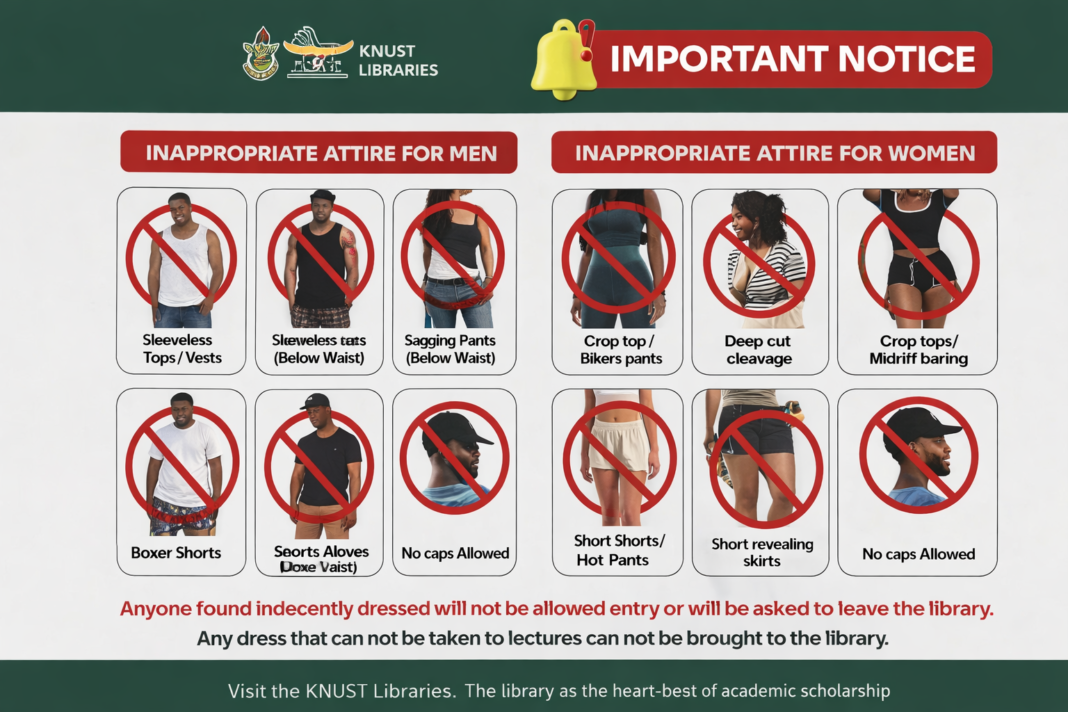
The KNUST Libraries has issued an important notice outlining a strict dress code policy aimed at maintaining discipline, decency, and a conducive academic atmosphere within its facilities.
According to the notice, students and visitors are expected to dress appropriately when accessing the library. The directive clearly highlights forms of dressing considered inappropriate for both men and women, emphasizing that the library is a formal academic space that demands respect and decorum.
For men, prohibited attire includes shirts with deep necklines, sleeveless tops or vests, sagging trousers worn below the waist, boxer shorts, shorts above knee length, and the wearing of caps within the library. Similarly, for women, the notice outlines restrictions on crop tops, biker pants, outfits exposing deep cleavage, midriff-baring clothing, short shorts, hot pants, revealing skirts, and the use of caps.
The management stressed that anyone found indecently dressed will either be denied entry or asked to leave the premises. Furthermore, the notice reinforces that any outfit deemed unsuitable for lectures is equally inappropriate for the library.
Dresses like:
🔴Inappropriate Attire for Men
Use visuals that clearly show:
- Sleeveless tops / vests
- Sagging trousers
- Boxer shorts / very short shorts
- Caps worn indoors
🔴 Inappropriate Attire for Women
Focus on:
- Crop tops / midriff-baring outfits
- Biker shorts / tight shorts
- Deep cleavage tops
- Short/revealing skirts
🚫 General “No Entry” / Dress Code Concept
These can be used for:
- Warning icons
- “No entry” signs
- Policy emphasis visuals
This move reflects the institution’s commitment to preserving the library as a space dedicated to serious academic work. By enforcing a standard of dressing, the library seeks to minimize distractions, encourage professionalism, and uphold the values of the university community.
Students are therefore advised to adhere strictly to these guidelines to avoid inconvenience and ensure uninterrupted access to library services.
By: Aboagye Yaw Ankomah