
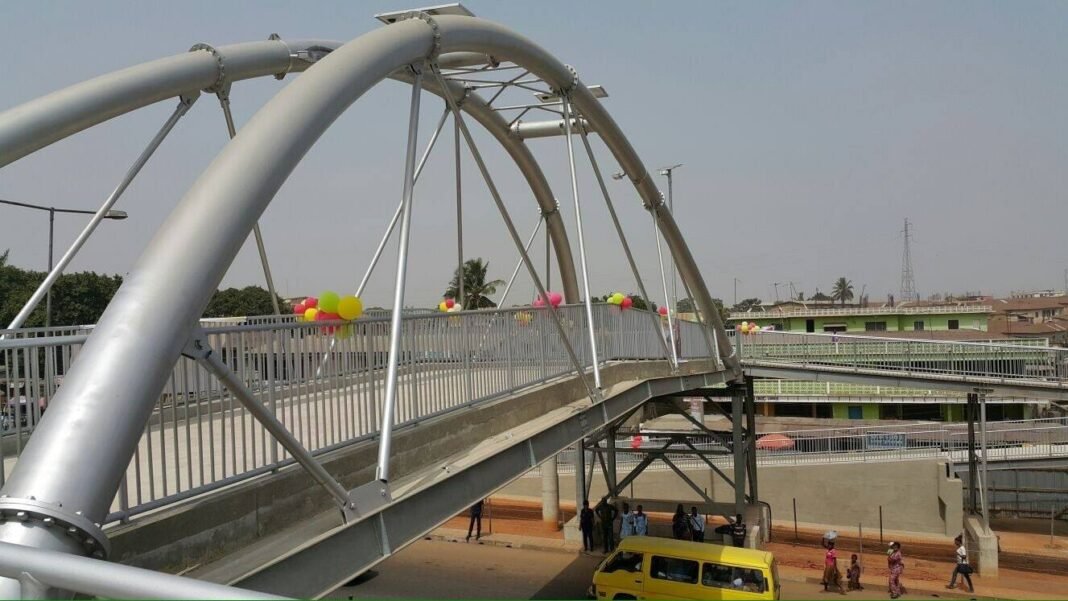


Running and Cycling Reduce Schoolchildren’s Use of Footbridges, Ghana Study Reveals.
A new study has found that schoolchildren in Ghana who are running or riding bicycles are significantly less likely to use pedestrian footbridges when crossing multi-lane highways, raising concerns about child road safety and the design of existing infrastructure.
The research, jointly conducted by scholars from the Kwame Nkrumah University of Science and Technology (KNUST) and partner institutions, was published in African Transport Studies. It examined the crossing behaviour of schoolchildren at seven footbridges located in the Greater Accra Metropolitan Area and Kumasi.
According to the findings, children who were observed running were 32.5 per cent less likely to use footbridges, while those cycling were 11.7 per cent less likely to do so. This trend persists despite footbridges being constructed specifically to reduce pedestrian-vehicle crashes on busy highways.
Overall compliance, however, was relatively high. Observers recorded a 91 per cent usage rate among 8,056 schoolchildren monitored over a seven-day period. Footbridge use was highest on Mondays, reaching 94.8 per cent, and was more common during morning hours between 7:00 and 9:00 a.m. Girls and children walking in groups were also more likely to use the bridges.
The study revealed that location played a significant role in determining usage. Compared with Lapaz, where children were only slightly more likely to use the footbridge, schoolchildren were 24.4 per cent less likely to use the Kwashieman footbridge and 12.8 per cent less likely to use the Madina footbridge. Lower usage rates were also recorded at the Mallam and Accra Mall sites.
Other factors influencing footbridge use included the day and time of observation, whether children were accompanied, and whether they were carrying luggage or wearing earphones. Children observed during the morning and late-morning periods were more likely to use footbridges than those seen between 3:00 and 5:00 p.m.
Interestingly, children who were accompanied, carrying bags, or wearing earphones showed higher levels of compliance. In contrast, speed-related activities such as running and cycling discouraged use. The researchers suggest that this may be due to the perceived time cost of climbing footbridges and designs that are not friendly to cyclists.
The study emphasizes that encouraging habitual footbridge use from an early age could improve long-term pedestrian safety. However, it cautions that continued non-use by some children “still portends danger,” especially given the high traffic volumes on urban highways.
To address these challenges, the authors recommend targeted road safety education, improved enforcement at footbridge locations, and design enhancements to make bridges more accessible and cyclist-friendly.
The paper, titled “An Observational Survey of the Use and Non-use of Footbridges by School Children in Ghana,” involved contributors from several institutions, including KNUST’s Department of Surgery, the University of Cape Coast, the University of Ghana, the Alabama Transportation Institute, and the Harborview Injury Prevention and Research Centre.
By: Aboagye Yaw Ankomah