
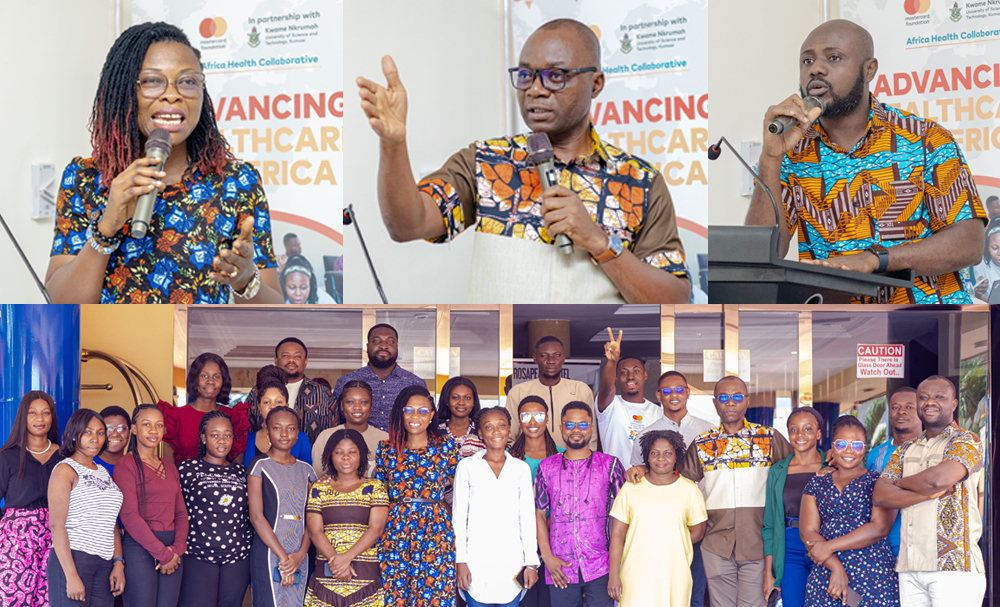


.KNUST Africa Health Collaborative Launches Fourth-Year Community Training in Health Entrepreneurship
The Africa Health Collaborative (AHC) at the Kwame Nkrumah University of Science and Technology (KNUST), Kumasi, has commenced its fourth-year Community-Based Training (CBT) programme in Health Entrepreneurship. The 10-day intensive training, delivered in partnership with the Mastercard Foundation, welcomed its first cohort of trainees for 2026.
The initiative is designed to equip emerging health professionals with entrepreneurial and intrapreneurial skills aimed at transforming Ghana’s health delivery system. By shifting focus from traditional employment pathways to innovation-driven practice, the programme seeks to nurture a new generation of solution-oriented health leaders.
Speaking at the opening session, Project Manager Eva Boakye Yiadom underscored the need for a mindset shift within the health sector. She encouraged participants to approach the training with openness and a willingness to rethink conventional approaches to healthcare delivery.
According to her, a persistent gap exists in the health workforce, where many graduates prioritise securing government employment over exploring innovative ventures. She noted that, in collaboration with the Mastercard Foundation, the programme aims to empower a health workforce capable of thinking beyond traditional employment structures and creating sustainable impact.
Lead Facilitator Dr. Isaac Tweneboa-Koduah described the training as a transformative experience intended to reposition health professionals as innovators and change-makers. He emphasised that meaningful reform in Ghana’s health delivery system requires collective effort and a strong sense of responsibility among practitioners.
Drawing comparisons between private and public healthcare institutions, Dr. Tweneboa-Koduah highlighted how efficiency, accountability, and business-oriented thinking often give private facilities a competitive edge. He stressed that adopting a mindset rooted in responsibility for patient wellbeing can significantly improve outcomes across the sector.
The training curriculum covers foundational principles of health entrepreneurship, pathways to health prosperity through entrepreneurship and intrapreneurship, the Health Hybrid Business Model Canvas, and strategies for managing health enterprises. Participants will be guided to identify pressing health challenges, develop scalable solutions, and explore viable business opportunities that may emerge during the programme.
Dr. Tweneboa-Koduah expressed optimism that some trainees could conceptualise and begin developing health enterprises within the 10-day period. He further noted that even those who pursue conventional employment must adopt intrapreneurial approaches characterised by efficiency, accountability, and solution-driven thinking within their organisations.
The sessions are facilitated by a multidisciplinary team comprising Gifty Afi Cudjoe, Richard Ntim Agyare, and Mohammed Maahi. In his closing remarks at the opening session, Mohammed Maahi urged participants to maximise the opportunity, highlighting the importance of networking and collaboration as integral components of the training experience.
The Community-Based Training programme forms part of the Africa Health Collaborative’s broader strategy to strengthen Africa’s health ecosystem by cultivating innovative, impact-driven professionals and shifting the narrative from employment seeking to solution creating.